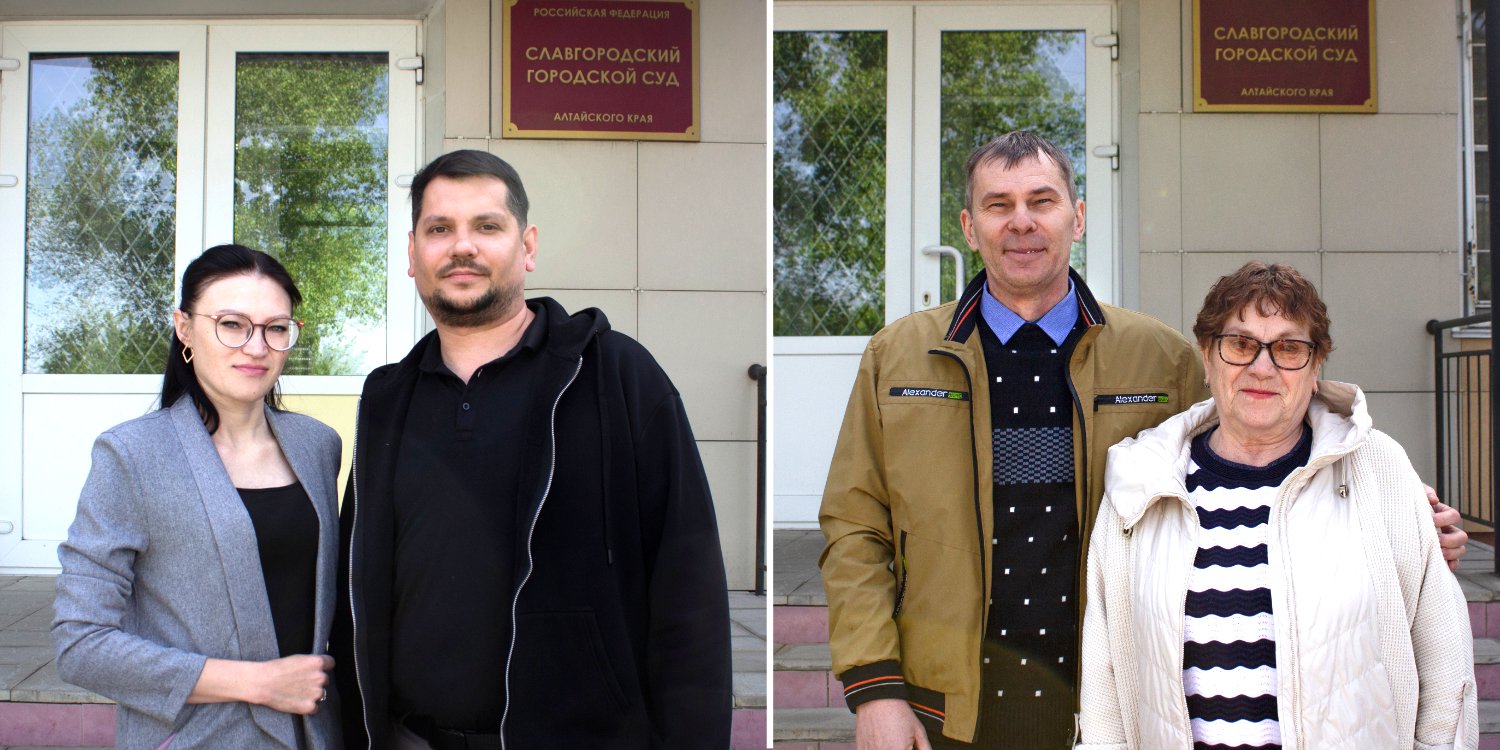
Alik Yeliseyev and Sergey Barsukov with their wives. May 2026.
Alik Yeliseyev and Sergey Barsukov with their wives. May 2026.
On May 18, 2026, the Slavgorod City Court of the Altai Territory announced its verdict against two local believers. Judge Olga Filippova sentenced Alik Yeliseyev and Sergey Barsukov to 6 years each in a penal colony. They were taken into custody in the courtroom and intend to appeal the verdict.
Sergey Barsukov, 54, has been married for about 30 years and has been one of Jehovah's Witnesses for nearly as long. He works as a repairman at a sports complex and is respected by both management and coworkers. "I have not harmed anyone — neither people nor the state," he said in his final statement. Barsukov had moved closer to his mother to care for her. His relatives worry about how this situation will affect her already fragile health.
Alik Yeliseyev, 35, is a third-generation Jehovah's Witness. From his teenage years he dreamed of starting his own business; today he runs a small key-cutting shop. Together with his wife, Alik is raising their 10-year-old son. After the search, the boy told his mother: "Mom, don't worry. They can take our devices and laptops, but they can't take away our faith." The prosecution has robbed the family of feeling safe: "We sleep badly... any knock or noise — and we already can't sleep."
A search of the Yeliseyevs' home took place in February 2025. As law enforcement officers entered the house, they knocked Alik to the floor. Threats were made during the search. Barsukov and Yeliseyev were charged with organizing the activity of an extremist organization 10 months later.
As in many other trials, the prosecution relied on a secret witness — in this instance a man called Panchenko. However, the secret witness said nothing that would indicate any real crimes by Yeliseyev or Barsukov: meetings for worship were held via videoconference, and participants read and discussed the Bible. According to those who attended the hearings, religious studies expert Mirra Kashchaeva tried to persuade the court that religious meetings of Jehovah's Witnesses are banned and that even words such as "thank you" and "please" spoken by the defendants could "indicate leadership of the congregation's activity."
In the Altai Territory, 12 Jehovah's Witnesses have already been prosecuted for their faith and 3 of them are serving their sentences in penal colonies.

